

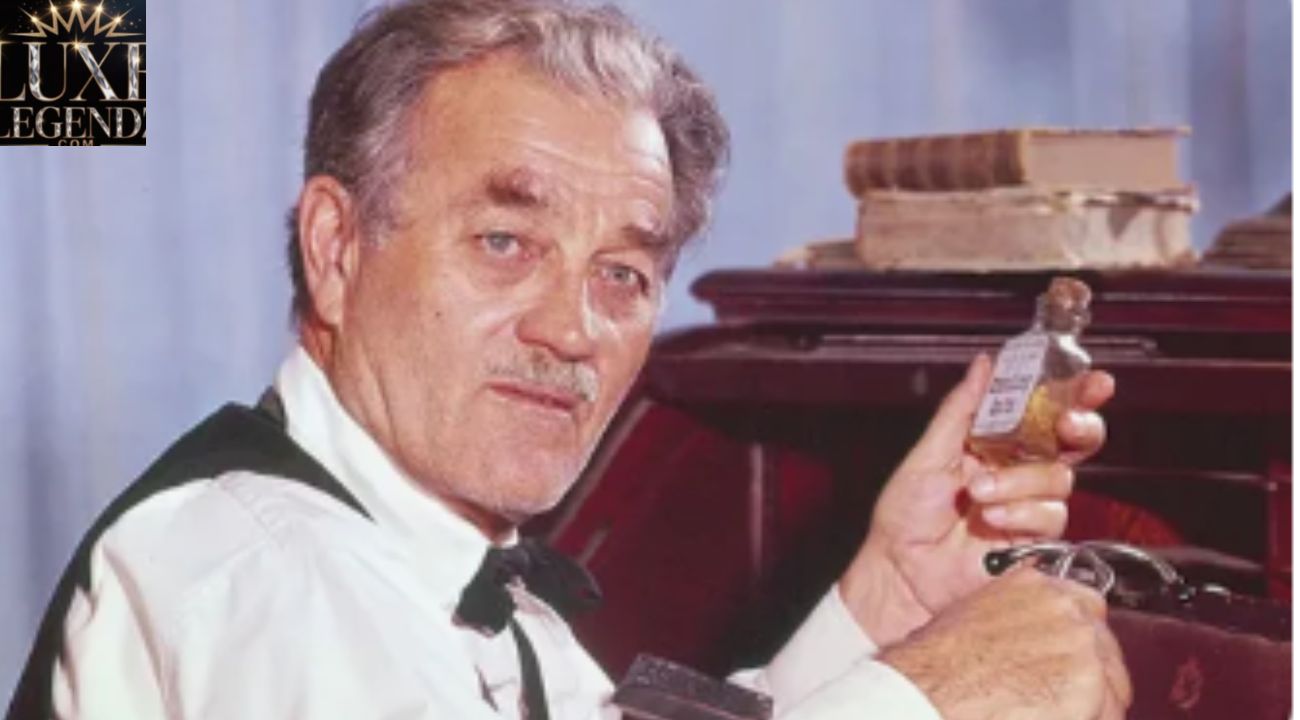
When people talk about the golden era of American television westerns, one name stands above almost all others in terms of loyalty, craft, and quiet dedication — Milburn Stone. Best remembered as the gruff yet warm-hearted Dr. Galen “Doc” Adams on Gunsmoke, Stone spent 20 years bringing one of TV’s most beloved characters to life. But beyond the iconic role, there’s a rich story of a Kansas-born kid who chose theater over the Naval Academy, built a career the hard way, and ultimately left behind a legacy that still resonates today.
Whether you’re curious about Milburn Stone’s net worth, his personal life and family, what he died of, or the theater named in his honor, this complete guide covers it all — backed by verified facts and detailed research.
Profile Summary
| Attribute | Details |
| Full Name | Hugh Milburn Stone |
| Date of Birth | July 5, 1904 |
| Place of Birth | Burrton, Kansas, USA |
| Date of Death | June 12, 1980 |
| Place of Death | La Jolla, California, USA |
| Age at Death | 75 years |
| Nationality | American |
| Profession | Actor |
| Most Famous Role | Doc Adams on Gunsmoke (CBS, 1955–1975) |
| Height | 5 ft 8 in (1.73 m) |
| Net Worth at Death | ~$600,000 (~$1.8 million in today’s value) |
| Spouse(s) | Ellen Morrison (m. 1925–d. 1937); Jane Garrison (m. and remarried) |
| Children | Shirley Stone Gleason (daughter) |
| Awards | Emmy Award (1968), Hollywood Walk of Fame Star |
| Burial | El Camino Memorial Park, Sorrento Valley, San Diego, CA |
Who Was Milburn Stone?
Milburn Stone was an American character actor whose career spanned more than four decades. Hugh Milburn Stone, born July 5, 1904, in Burrton, Kansas, became one of Hollywood’s most recognizable faces through his role as Dr. Galen Adams — known simply as “Doc” — in the long-running CBS Western series Gunsmoke.
He wasn’t an overnight success. Stone spent years grinding through bit parts, B-movies, serials, and stage productions before landing the role that would define his career. What made him remarkable wasn’t just his talent — it was his commitment. He stayed with Gunsmoke for its entire 20-year television run, missing only a handful of episodes due to a health crisis in 1971.
Stone was the kind of actor Hollywood needed but rarely celebrated loudly: dependable, versatile, deeply skilled, and always willing to put the story above the spotlight.
Early Life and Education

Stone was born to Herbert Stone and the former Laura Belfield. He graduated from Burrton High School, where he was active in the drama club, played basketball, and sang in a barbershop quartet. From an early age, it was clear that performing was in his blood.
His uncle, Fred Stone, was a well-known Broadway comedian and circus performer — a direct influence on young Milburn’s ambitions. Although Stone had a congressional appointment to the United States Naval Academy, he turned it down, choosing instead to become an actor with a stock theater company headed by Helen Ross. That decision, bold for a small-town Kansas kid in the early 1920s, set the entire trajectory of his life.
In 1919, Stone debuted on stage in a Kansas tent show. He ventured into vaudeville in the late 1920s, and in 1930, he was half of the Stone and Strain song-and-dance act. His Broadway credits would later include Around the Corner (1936) and Jayhawker (1934), modest but meaningful steps toward Hollywood.
Acting Journey and Career Highlights
The Early Hollywood Years (1930s–1940s)
Stone arrived in Los Angeles in the mid-1930s with little more than stage experience and a determination to make it on screen. The early years were tough. He toiled for years in mostly unbilled parts for ‘poverty row’ Monogram Pictures and a few major studios, apprenticing in a number of background roles as both benign fellows (clerks, reporters, sailors, detectives) and bad guys (convicts, robbers, henchmen).
His role variety during this period was extraordinary. He played everything from a reporter in Cheers of the Crowd (1935) to a henchman in The Fighting Marines (1935 serial). One memorable featured part was as debater Stephen A. Douglas in John Ford’s Young Mr. Lincoln (1939). This was a prestigious, if uncredited, assignment — working under one of Hollywood’s legendary directors.
Stone was signed by Universal Pictures in 1943 and became a familiar face in its features and serials. He made such an impression in the film I’ll Remember April that Universal gave him a starring role in the 1945 serial The Master Key.
Breakthrough Moments Before Gunsmoke
By the early 1950s, Stone had accumulated an impressive resume of character roles. In 1953, Stone appeared as Charlton Heston’s sidekick in Arrowhead, a Western also featuring Brian Keith and Katy Jurado. These kinds of supporting roles — always skillful, rarely headlining — kept Stone visible and respected in Hollywood circles.
He was the quintessential character actor: the kind of performer directors trusted because he was always prepared, always believable, and always made those around him better.
Milburn Stone’s Daughter
Stone had a surviving daughter, Shirley Stone Gleason, born around 1926, from his first marriage of 12 years to Ellen Morrison, formerly of Delphos, Kansas, who died in 1937. Shirley grew up without her mother, who passed away at just 31 years old from heart trouble while the family was living in California.
Shirley Stone Gleason went on to lead a private life away from Hollywood. She married and settled in California, and by most accounts, chose to stay well clear of the entertainment industry spotlight her father occupied for decades. She passed away in 2001, having outlived her famous father by more than two decades.
Rise to Fame as “Doc Adams” on Gunsmoke
The Role That Changed Everything
When CBS decided to adapt its enormously popular radio western Gunsmoke for television in 1955, the casting choices were critical. Howard McNear, the radio Doc Adams (who later played Floyd the barber on The Andy Griffith Show), was replaced by Stone, who gave the role a harder edge consistent with his screen portrayals.
It was a perfect fit. Stone brought a gruff authenticity and a dry wit to Doc Adams that made the character feel utterly real. The crusty but sympathetic Doc Adams hung out his shingle in Gunsmoke‘s Dodge City for 20 years. Between presiding over births and treating the requisite gunshot wounds, he could often be found counseling Marshal Dillon, bemusing Miss Kitty, or needling regulars like Chester and Festus over beers at The Longbranch Saloon.
Interestingly, Stone didn’t just create the character from thin air. The Burrton town doctor, Joseph Wakefield Myers MD, served from 1913 to 1928, and Hugh was known to have said he styled his portrayal of a country doctor based on Dr. Myers. That personal connection gave Doc Adams a realism that audiences immediately recognized and trusted.
20 Years, 604 Episodes
Stone appeared in 604 episodes through 1975, often shown sparring in a friendly manner with co-stars Dennis Weaver and Ken Curtis, who played, respectively, Chester Goode and Festus Haggen.
In 1971, his health forced a temporary departure. At the University of Alabama Hospital, Milburn had coronary artery bypass surgery. During the operation, Stone had two clinical deaths. It was an extraordinarily close call. Yet Stone recovered and returned to the show, missing only seven episodes in total across the entire run.
Gunsmoke is still the longest-running dramatic series in American network television history — a record that speaks to the quality of every cast member, Stone very much included.
Milburn Stone’s Net Worth

Net Worth at Time of Death
Milburn Stone’s estimated net worth at the time of his death in 1980 was approximately $600,000, which adjusts to roughly $1.8 million in today’s currency when accounting for inflation.
Stone made his fortune by acting in 168 movies, including Sky Patrol, Smoke Signal, The Judge, The Long Gray Line, No Man of Her Own, Black Tuesday, and Arrowhead. However, Gunsmoke earned him most of his wealth.
One notable financial decision stands out from his career: In 1961, Milburn sold his residual rights of Gunsmoke to CBS for $100,000. In retrospect, given the show’s enduring syndication success, this was likely a decision he may have reconsidered later in life.
How Milburn Stone Built His Wealth
Stone’s financial foundation was built on three pillars:
1. Gunsmoke Salary His 20-year run on one of America’s most-watched television shows provided steady, substantial income. While the exact per-episode figures weren’t publicly disclosed, his co-star Burt Reynolds reportedly earned around $3,000 per week as a supporting cast member. As a main cast member across the entire run, Stone’s compensation would have been significantly higher, particularly in the show’s later seasons.
2. Film Career (168 Movies) Before Gunsmoke and during its run, Stone appeared in well over 100 films. From low-budget serials at Monogram Pictures to Universal features and major studio productions, his film work generated steady income throughout the 1930s, 1940s, and 1950s.
3. Syndication and Residuals Gunsmoke continued to air in syndication long after its 1975 cancellation, generating ongoing royalty income. While Stone sold his residual stake in 1961, the show’s widespread syndication throughout his later years represented ongoing cultural — if not always direct financial — capital.
After Gunsmoke ended in 1975, Stone maintained a comfortable financial status due to his earlier successes. Stone’s financial legacy was bolstered by smart investments and savings, which helped him remain financially stable in his later years.
Comparison with Co-Stars’ Net Worth
To put Milburn Stone’s wealth in context, here’s how it compared to his Gunsmoke colleagues:
| Actor | Character | Net Worth at Death | Modern Equivalent |
| James Arness | Marshal Matt Dillon | $8 million (2011) | ~$11 million |
| Dennis Weaver | Chester Goode | $16 million (2006) | ~$24 million |
| Burt Reynolds | Quint Asper | $3 million (2018) | ~$3.5 million |
| Milburn Stone | Doc Adams | $600,000 (1980) | ~$1.8 million |
| Amanda Blake | Miss Kitty | $500,000 (1989) | ~$1.2 million |
Stone was the only actor besides Arness to stick around for all 20 seasons of Gunsmoke, yet Weaver had the highest net worth at the time of his death in 2006, reportedly $16 million — largely because he left the show early to pursue a broader, more commercially diverse career.
Stone’s comparatively modest accumulation reflects both the era in which he worked and his preference for staying loyal to one project rather than diversifying into production ownership or other business ventures the way Arness did.
Awards, Achievements, and Career Impact
Milburn Stone’s recognition from the industry was meaningful, if not as frequent as his talent deserved:
- 1968 Emmy Award — Outstanding Performance by an Actor in a Supporting Role in a Drama (Gunsmoke)
- 1971 Golden Globe Nomination — Best Supporting Actor in a Television Series (did not win)
- Hollywood Walk of Fame Star — Located at 6801 Hollywood Boulevard, honoring his contribution to the television industry
- 1975 Honorary Doctorate — From St. Mary of the Plains College in Dodge City, Kansas, where Gunsmoke was set but not filmed
- 1981 Western Performers Hall of Fame — Inducted posthumously into the Western Performers Hall of Fame at the National Cowboy & Western Heritage Museum in Oklahoma City
The Emmy win in 1968 was particularly significant — it came after 13 years on the show, a belated but genuine recognition of just how much Stone had been doing right all along.
Milburn Stone Theatre
After his death, Stone left a legacy for the performing arts in Cecil County in northeastern Maryland, by way of the Milburn Stone Theatre in North East, Maryland.
The Milburn Stone Theatre is located at Cecil College in North East, Maryland, and serves as the region’s primary venue for theatrical productions. It hosts a full season of plays, musicals, and community events annually. Named in Stone’s honor, the theater represents one of the most tangible tributes to his life and artistic legacy — connecting future generations of performers to the spirit of a man who gave up a Naval Academy appointment to follow his love of the stage.
For theater lovers in the mid-Atlantic region, a visit to the Milburn Stone Theatre is a meaningful way to connect with this icon’s enduring influence.
Personal Life, Family, and Relationships
First Marriage: Ellen Morrison
On June 23, 1925, Milburn Stone married Nellie (Ellen) Kelman Morrison of Delphos, Kansas. To this union was born one daughter, Shirley Joan. The marriage lasted 12 years before tragedy struck. Ellen died suddenly in Hollywood in October 1937 from heart trouble, leaving Stone a widower with a young daughter. She was only 31 years old.
Second Marriage: Jane Garrison
Stone later met and married Jane Garrison, a native of Hutchinson, Kansas. Their relationship was complex — the two married, divorced, and then remarried. Stone was married to Jane Garrison, and his wife passed away much later in 2002.
Personal Connections and Character
Stone was known in Hollywood circles as a serious, dedicated professional. He was friends with Ronald Reagan, who later became the 40th President of the United States. When Reagan heard about a painting of the Doc Adams character commissioned from Kansas artist Gary Hawk, he invited the painter to the Oval Office to present the artwork to the President.
His brother, Joe Stone, was a writer who penned scripts for three episodes of Gunsmoke. His family connections to entertainment were deep — his uncle Fred Stone was a Broadway star, and he was related to character actress Madge Blake.
Stone’s lifestyle in his later years was notably modest. He retired to a ranch following the end of Gunsmoke in 1975 and reportedly enjoyed hobbies like fishing. There was no extravagance, no Hollywood drama — just a man who had done what he loved for 50 years and was content to step back quietly.
Milburn Stone Movies and TV Shows
Selected Filmography
Television:
- Gunsmoke (1955–1975) — Doc Adams (604 episodes)
Films (Selected):
| Year | Film | Role |
| 1935 | Ladies Crave Excitement | Sailor (uncredited) |
| 1935 | The Fighting Marines (serial) | Red, Henchman |
| 1937 | Federal Bullets | Lead role |
| 1939 | Young Mr. Lincoln | Stephen A. Douglas |
| 1944 | The Great Alaskan Mystery (serial) | Featured role |
| 1945 | The Master Key (serial) | Lead role |
| 1949 | Sky Patrol | Featured role |
| 1949 | The Judge | Lead role |
| 1952 | The Atomic City | Inspector Harold Mann |
| 1953 | Arrowhead | Charlton Heston’s sidekick |
| 1953 | Invaders from Mars | Captain Roth |
| 1954 | Siege at Red River | Sgt. Guderman |
| 1955 | The Long Gray Line | Capt. John Pershing |
| 1955 | Smoke Signal | Sergeant Miles |
| 1957 | Drango | Colonel Bracken |
Over the course of his career, Stone appeared in more than 168 film and television productions — a body of work that showcases extraordinary range across westerns, crime dramas, serials, comedies, and war films.
Legacy and Influence in Hollywood
Milburn Stone’s legacy is quiet but enduring. He didn’t build an empire, didn’t chase headlines, and didn’t reinvent himself for new audiences every decade. What he did was simpler and rarer: he showed up, he did the work, and he made everything around him better.
Doc Adams remains one of the best-written and best-performed supporting characters in the history of American television. Stone understood the character’s function — to be the moral center, the voice of reason, the person who dealt with the human cost of frontier violence — and he never played it for cheap laughs or easy sentimentality.
His influence on the western genre specifically is substantial. Doc Adams set a template for how a “town doctor” character could carry dramatic weight equal to any gunfighter. That template has been followed — consciously or not — in dozens of westerns and period dramas since.
Beyond performance, Stone’s dedication to craft over celebrity is a model worth honoring. In an industry often defined by ego and self-promotion, his quiet professionalism stands apart.
The Milburn Stone Theatre at Cecil College continues to bear his name and purpose — nurturing new generations of performers in the same spirit that led a Kansas teenager to choose theater over the Naval Academy more than a century ago.
What Did Milburn Stone Die Of?

Milburn Stone died of a heart attack on June 12, 1980, in La Jolla, California. He was 75 years old.
His cardiac history was significant. In 1971, at the University of Alabama Hospital, Milburn had coronary artery bypass surgery — a procedure to restore normal blood flow to an obstructed coronary artery. During the operation, Stone had two clinical deaths. He survived that ordeal and returned to Gunsmoke for four more years.
After the show ended in 1975, Stone retired to his ranch. Fully retired to his ranch in 1975 after the show’s cancellation, he was eventually awarded an honorary doctorate from St. Mary of the Plains College in Dodge City, Kansas.
The heart attack that took his life in 1980 was ultimately a continuation of the cardiac vulnerabilities that had plagued him for nearly a decade. He was buried at the El Camino Memorial Park in Sorrento Valley, San Diego.
His second wife Jane Garrison survived him and passed away in 2002, 22 years after Stone.
FAQs About Milburn Stone
Q: What was Milburn Stone’s net worth?
At the time of his death in 1980, Milburn Stone’s net worth was approximately $600,000, which equals roughly $1.8 million in today’s money adjusted for inflation.
Q: What did Milburn Stone die of?
Milburn Stone died of a heart attack on June 12, 1980, in La Jolla, California, at the age of 75. He had previously undergone coronary bypass surgery in 1971.
Q: Who was Milburn Stone’s daughter?
His daughter was Shirley Stone Gleason, born around 1926 from his first marriage to Ellen Morrison. Shirley led a private life and passed away in 2001.
Q: What is the Milburn Stone Theatre?
The Milburn Stone Theatre is a performing arts venue at Cecil College in North East, Maryland, named in his honor after his death in 1980.
Q: How many episodes of Gunsmoke did Milburn Stone appear in?
Stone appeared in approximately 604 episodes of Gunsmoke across its 20-year run (1955–1975), missing only seven due to heart surgery in 1971.
Q: Did Milburn Stone win an Emmy Award?
Yes — Stone won the Emmy Award for Outstanding Performance by an Actor in a Supporting Role in a Drama in 1968 for his work on Gunsmoke.
Q: Who replaced Milburn Stone during his absence from Gunsmoke?
Actor Pat Hingle temporarily replaced Stone as Dr. Chapman during Stone’s recovery from heart bypass surgery in 1971.
Q: Was Milburn Stone related to any other famous actors?
Yes — he was the nephew of Broadway comedian Fred Stone and was related to character actress Madge Blake, who appeared in the TV series Batman.
Q: Where is Milburn Stone buried?
He is buried at El Camino Memorial Park in Sorrento Valley, San Diego, California.
Q: Did Milburn Stone have a star on the Hollywood Walk of Fame?
Yes, Milburn Stone has a star on the Hollywood Walk of Fame, located at 6801 Hollywood Boulevard.
Conclusion
Milburn Stone was, in every meaningful sense, the backbone of American television’s most successful western. For 20 straight years, he walked into Gunsmoke‘s version of Dodge City and made audiences believe in Doc Adams — not as a fictional character, but as a real person who cared about his patients, his community, and the dignity of human life on the frontier.
His story — from a Kansas barbershop quartet singer who turned down the Naval Academy to a Hollywood Walk of Fame honoree — is the kind of authentic American journey that doesn’t get written about enough. He wasn’t the biggest earner in the Gunsmoke cast. He wasn’t the most famous name. But he may well have been its most essential performer.
The Milburn Stone Theatre stands as proof that his legacy outlasted him. A theater bearing your name, nurturing performers you’ll never meet — that’s a contribution that no net worth figure can fully capture. Milburn Stone built something that mattered, and it still does.
