

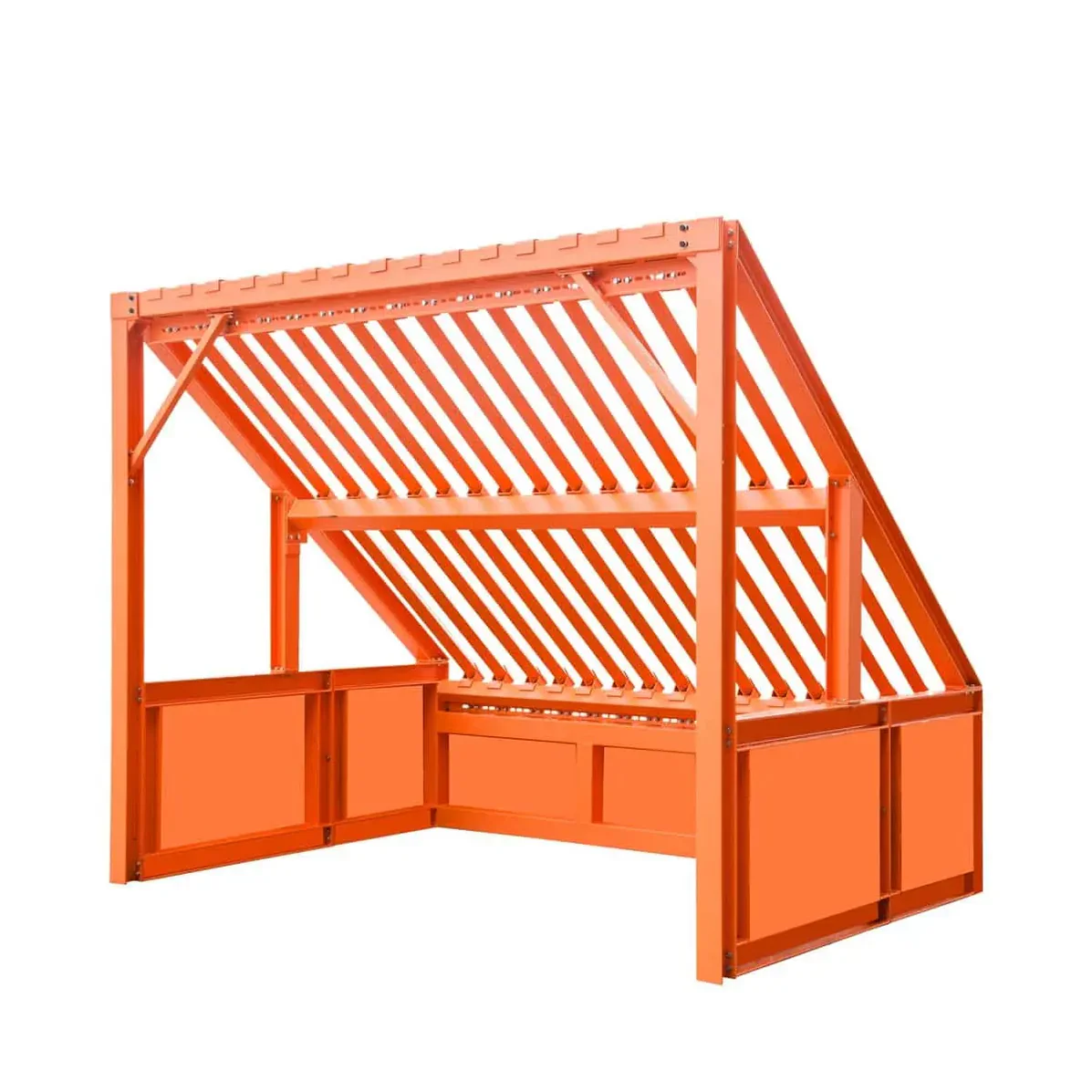
On Canadian building sites through the summer, the ground that comes out of a foundation or a trench is rarely uniform. It arrives as a jumble of topsoil, clay, cobble, and boulders, and mixed together that spoil is useful for almost nothing.
Sorting it back into grades that a crew can actually reuse is the job of a rock screen, a grid of steel bars that parts a load by the one property that matters most on a site, which is size.
A grid that sorts purely by the size of the gap
The working principle of a rock screen is disarmingly simple. Bars are spaced at a set distance, and anything smaller than that gap falls through while anything larger is held back and carried on.
There is no measuring and no sorting by hand. The spacing itself makes the decision, and every stone in the load is judged against the same fixed opening as it tumbles across the steel.
That single dimension is chosen for the job ahead. A rock screen set with narrow gaps yields fine planting soil, while wider bars pass a coarser fill and hold back only the true cobble, so the same frame can be tuned to what the site needs.
Also Read: How AR Passthrough Improves Virtual Reality Experiences
Agitation is what frees the fines from the coarse
A still grid would simply clog, so the load has to move. As an excavator or loader tips material across the face of a rock screen, the stone rolls and tumbles down the incline, and that motion shakes the fine soil loose from between the larger pieces.
Without the tumbling, damp soil would bridge the gaps and ride over the top with the rock. The agitation breaks those clumps apart so the fines can find an opening and drop through where they belong. The steeper the face, the more the load rolls, and the more thoroughly each stone is scrubbed clean of the soil clinging to it.
•Bar spacing: sets the single cut-off size
•Tumbling action: shakes fines out of clumps
•Steep face: keeps material moving downward
•Oversize stone: rides over to a separate pile
Keeping the coarse and passing the fine
The result of one pass is two clean streams from a single mixed pile. The fine soil that falls through gathers below as backfill or planting material, while the boulders and cobble held back roll off the end to be stockpiled as rock or hauled away.
A landscaper stripping a lot, for instance, can reclaim the screened topsoil for regrading and set the culled stone aside for a drainage bed, all from the same load the excavator was going to move anyway. What once left the site as waste now stays on it as two ready materials.
•Undersize soil: drops through as clean backfill
•Oversize rock: kept back for stone stockpiles
•One pass: turns mixed spoil into two grades
•Reused material: cuts hauling and import cost
Seen this way, the tool does nothing more than apply one rule, over and over, faster than any crew could by hand. The spacing of the bars and the tumbling of the load together decide what stays coarse and what passes fine, turning a heap of waste into two useful grades.
For a Canadian contractor moving summer spoil, a well-matched rock screen is what separates a pile of problems into materials worth keeping.
